









Centre for Quantum Science and Technology
CENTRE FOR QUANTUM SCIENCE AND TECHNOLOGY
About the Centre:
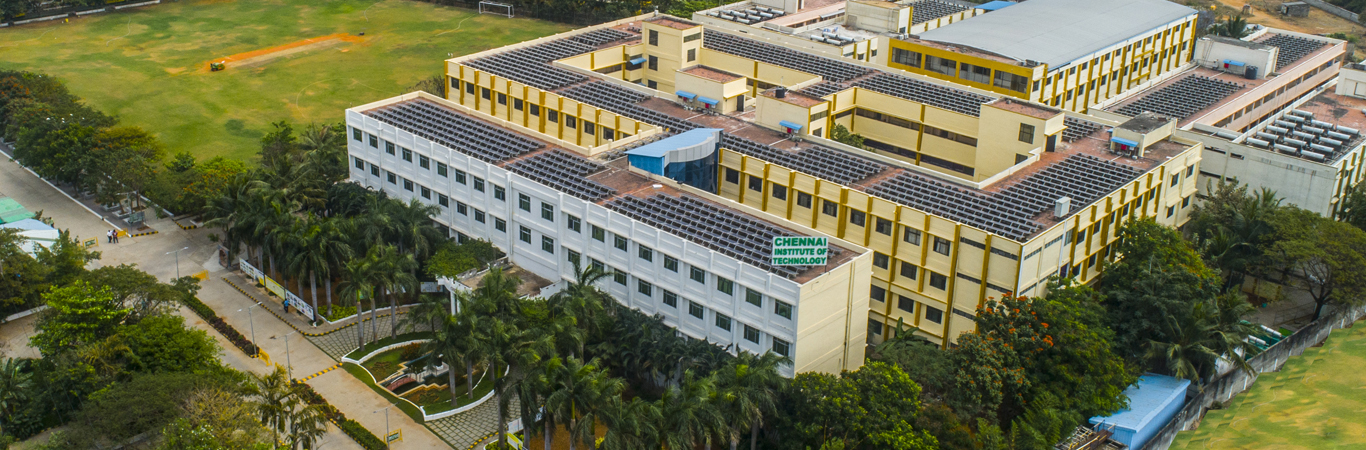
The Centre for Quantum Science and Technology (CQST) at Chennai Institute of Technology (CIT) is committed to advancing quantum science and its applications. Recent developments in quantum technologies have revolutionized the fields of computation, communication, and sensing. Quantum computers now solve complex problems beyond the reach of classical computers. Quantum communication technologies, through quantum key distribution, provide potentially unbreakable encryption. Quantum sensors, utilizing phenomena such as superposition and entanglement, achieve unprecedented precision and sensitivity in measurement. Scientists are also exploring quantum batteries and quantum heat engines for enhanced efficiency. These innovations, driven by academic research and industry investment, herald a new era of technological transformation. CIT-CQST prioritizes the development of research facilities for emerging quantum technologies.
Vision:
The vision of the Centre for Quantum Science and Technology is to establish a world-class research facility dedicated to advancing quantum technologies. CQST aims to investigate quantum resources, model realistic quantum devices, develop protocols for quantum technologies, and assess their real-world applications. The Center endeavors to establish robust research collaborations at both national and international levels. CQST is committed to nurturing the next generation of quantum scientists and engineers, empowering them to shape the future of quantum technology for strengthening our nation.
Mission:
- To establish an eminent research center of quantum science and technology, enhancing the national and international collaborations in both theory and experiment.
- To generate new knowledge in quantum science and technology and to develop professional skills in the quantum technology landscape.
- To undertake collaborative projects that offer opportunities for long-term interaction with other Institutes, R&D laboratories, and Quantum Tech Industry.
- To Mentor motivated students from scratch to advance state-of-the-art knowledge of quantum technology, preparing them for future quantum ecosystems.
Specific Objectives:
- Advance research in the frontiers of quantum information science, quantum computation, quantum communication, quantum network, open quantum systems, quantum thermodynamics, quantum thermal machines, and quantum transport.
- Innovate efficient protocols for quantum-enabled communication, unconditional security of communication, for quantum energy storage devices, and for quantum-enhanced metrology and sensing, explore new techniques for certification of quantum devices.
- Develop quantum algorithms for realistic quantum computers, quantum software tools to study complex systems, quantum computing under noisy environment, decoherence, quantum resources and decoherence control in quantum devices.
- Investigate new features for quantum materials for emerging quantum technology, quantum many-body phenomena/quantum materials, quantum condensed matter physics, nonequilibrium quantum transport in nanostructures
Thrust Areas
- Quantum information and quantum computation
- Quantum communication and quantum network
- Quantum algorithms and quantum simulation software
- Open quantum systems and quantum thermodynamics
- Quantum thermal machines and quantum batteries
- Quantum control, quantum metrology and sensing
- Quantum many-body phenomena/quantum materials
- Quantum condensed matter physics and quantum transport
Frequently Asked Questions
| Sl No. | Faculty Name | Designation |
| 1. | Dr. Md Manirul Ali | Professor & Director |
| 2. | Dr. Monodeep Chakraborty | Professor |
| 3. | Dr. Shiladitya Mal | Associate Professor |
| 4. | Mr. Saikumar Krithivasan | Assistant Professor |
List of Papers (in reverse Chronological order):
| [31] Pritam Roy, Subhankar Bera, AS Majumdar, Shiladitya Mal, Robust certification of quantum instruments through a sequential communication game, Phys. Rev. A 113, 022611 (2026). https://doi.org/10.1103/nw61-nwj7 |
| [30] Ayan Patra, Shiladitya Mal, Aditi Sen(De), Coherence measure of ensembles with nonlocality without entanglement, Phys. Lett. A 554, 130760 (2025). https://doi.org/10.1016/j.physleta.2025.130760 |
| [29] Vinayak Jagadish and R. Srikanth, Eternal non-Markovianity of qubit maps, Phys. Rev. A 111, 042212 (2025) https://doi.org/10.1103/PhysRevA.111.042212 |
| [28] P. W. Chen, R. Chandrashekar, Md Manirul Ali, Enhanced quantum synchronization of a driven qubit under structured reservoir, APL Quantum 2, 016109 (2025) https://doi.org/10.1063/5.0242574 |
| [27] S. A. Siddique, Md Manirul Ali, Arijit Sen, Enhancing the Charging Capacity of Many-Body Quantum Batteries through Landau-Zener Driving, Adv. Quantum Technol. e2500098 (2025). https://doi.org/10.1002/qute.202500098 |
| [26] S. Roy, K. Aahaman, R. Chandrashekar, and Md Manirul Ali, Environment engineering to protect quantum coherence in tripartite systems under dephasing noise, Int J Theor Phys 64, 132 (2025) https://doi.org/10.1007/s10773-025-05995-7 |
| [25] Saikumar K, T.Y. Meitei, Arijit Sen, Md Manirul Ali, Interplay of Quantum Coherence and Nonequilibrium Quantum Transport: An Exact Density Matrix Formulation in the Heisenberg Framework, arXiv https://doi.org/10.48550/arXiv.2502.12105 |
| [24] Dephasing-Induced Distribution of Entanglement in Tripartite Quantum Systems, S. Roy, Md Manirul Ali, A. Mandal, R. Chandrashekar; Modern Physics Letters A 40, 2550082 (2025). https://doi.org/10.1142/S0217732325500828 |
| [23] Monodeep Chakraborty, and Holger Fehske, Quantum transport in an environment parametrized by dispersive bosons, Phys. Rev. B 109, 085125 (2024) https://doi.org/10.1103/PhysRevB.109.085125 |
| [22] Ravi Kiran, Sudipta Biswas, and Monodeep Chakraborty, Effect of correlated disorder on superconductivity in a kagome lattice: A Bogoliubov-de Gennes analysis, Phys. Rev. B 110, 184506 (2024) https://doi.org/10.1103/PhysRevB.110.184506 |
| [21] S. Datta, Shiladitya Mal, A. K. Pati, A. S. Majumdar, Remote state preparation by multiple observers using a single copy of a two-qubit entangled state, Quantum Inf. Process. 23, 54 (2024). https://doi.org/10.1007/s11128-024-04263-7 |
| [20] K. S. Chen, Shiladitya Mal, G. N. Tabia, Y. C. Liang, Hardy-type paradoxes for an arbitrary symmetric bipartite Bell scenario, Phys. Rev. A 109, 042206 (2024) https://doi.org/10.1103/PhysRevA.109.042206 |
| [19] L. G. Lakkaraju, Shiladitya Mal, Aditi Sen (De), Necessary condition for information transfer under simulated parity-time-symmetric evolution, Phys. Scr. 99, 065115 (2024) https://iopscience.iop.org/article/10.1088/1402-4896/ad4425 |
| [18] T.Y. Meitei, Saikumar K, Arijit Sen, Md Manirul Ali, Quantumness in the electronic transport of quantum dot devices through Leggett-Garg inequalities, Physica A 655, 130160 (2024) https://doi.org/10.1016/j.physa.2024.130160 |
| [17] S. Roy, A. Kumari, Shiladitya Mal, Aditi Sen (De), Robustness of higher-dimensional nonlocality against dual noise and sequential measurements, Phys. Rev. A 109, 062227 (2024) https://doi.org/10.1103/PhysRevA.109.062227 |
| [16] R. Chandrashekar, Sovik Roy, R. Chinnarasu, Md Manirul Ali, Entanglement preservation in tripartite quantum systems under dephasing dynamics, Europhys. Lett. 146, 38001 (2024) https://doi.org/10.1209/0295-5075/ad3eac |
| [15] Md Manirul Ali, P. W. Chen, R. Chandrashekar, Detecting quantum phase localization using Arnold tongue, Physica A 633, 129436 (2024) https://doi.org/10.1016/j.physa.2023.129436 |
| [14] Saveetha Harikrishnan, P. P. Rohde, R. Chandrashekar, Quantum conditional mutual information of W-State in non-inertial frames, Phys. Scr. 99 025106 (2024) https://iopscience.iop.org/article/10.1088/1402-4896/ad190d |
| [13] A. Bhattacharjee, S. Roy, Md Manirul Ali and B. Ghosh, Non-maximally Entangled Mixed States of X and Non-X Types as Teleportation Channels, Int. J. Theor. Phys. (Springer) 63, 113 (2024) https://doi.org/10.1007/s10773-024-05638-3 |
| [12] Monodeep Chakraborty, Jayita Chatterjee and Holger Fehske, Particularities of polaron formation in the extended Holstein model with next nearest neighbor transfer, Phys. Rev B 108, 235134 (2023) https://doi.org/10.1103/PhysRevB.108.235134 |
| [11] Madhuparna Karmakar, Temperature-tuned Fermi-surface topology and segmentation in non-centrosymmetric superconductors, Phys. Rev. B 107, 064503 (2023) https://doi.org/10.1103/PhysRevB.107.064503 |
| [10] Md Manirul Ali, Rohith Dinakaran and R. Chandrashekar, Coherence crossover dynamics in the strong coupling regime, Physica A 614, 128520 (2023) https://doi.org/10.1016/j.physa.2023.128520 |
| [9] Md Manirul Ali, Bell’s theorem in time without inequalities, Europhys. Lett. 143, 38001 (2023) https://iopscience.iop.org/article/10.1209/0295-5075/ace9f7 |
| [8] Md Manirul Ali, Quantum uncertainty dynamics, Found. Phys. (Springer) 53, 32 (2023) https://doi.org/10.1007/s10701-023-00672-3 |
| [7] S. Roy, A. Bhattacharjee, R. Chandrashekar, Md Manirul Ali, B. Ghosh, Exploring quantum properties of bipartite mixed states under coherent and incoherent basis, Int. J. Quantum Inf. (World Scientific) 21, 2350010 (2023) https://doi.org/10.1142/S0219749923500107 |
| [6] Monodeep Chakraborty, S. S. Narayan, Vigneshwaran R., and M. Berciu, “Role of long-range coupling in the properties of single polarons in models with dual electron-phonon couplings”, Phys. Rev. B 106, 035133 (2022) https://doi.org/10.1103/PhysRevB.106.035133 |
| [5] Madhuparna Karmakar, S. Roy, S. Mukherjee, and R. Narayanan, Disorder stabilized breached-pair phase in an s-wave superconductor, Phys. Rev. Res. 4, 043159 (2022) https://doi.org/10.1103/PhysRevResearch.4.043159 |
| [4] Md Manirul Ali, R. Chandrashekar and S. S. Naina Mohammed, Quantum coherence dynamics of displaced squeezed thermal state in a non-Markovian environment, Quantum Inf. Process. (Springer) 21, 193 (2022) https://doi.org/10.1007/s11128-022-03535-4 |
| [3] N. Swain, Madhuparna Karmakar, and Pinaki Majumdar, Spin-orbital liquids and insulator-metal transitions on the pyrochlore lattice, Phys. Rev. B 106, 245114 (2022) https://doi.org/10.1103/PhysRevB.106.245114 |
| [2] Saveetha Harikrishnan, S. Jambulingam, P. P. Rohde, and R. Chandrashekar, Accessible and inaccessible quantum coherence in relativistic quantum systems, Phys. Rev. A 105, 052403 (2022) https://doi.org/10.1103/PhysRevA.105.052403 |
| [1] Z. Ding, R. Liu, R. Chandrashekar et al. Experimental study of quantum coherence decomposition and trade-off relations in a tripartite system, npj Quantum Inf. 7, 145 (2021) https://doi.org/10.1038/s41534-021-00485-0 |
*Applications from International researchers are mostly welcome
For Details, Contact:
Dr. Md Manirul Ali
Director, Centre for Quantum Science and Technology
Professor, Department of Physics, Chennai Institute of Technology
Chennai-600069. Email: manirul@citchennai.net
 Research
- Centre for Research
- Centre for Advanced Wireless Integrated Technology (CAWIT)
- Centre for Artificial Intelligence
- Centre for Sustainable Materials and Surface Metamorphosis (CSMSM)
- Centre for mruby
- Centre for Quantum Science and Technology
- Centre for Advanced Multidisciplinary Research and Innovation – CAMRI
- Centre for Applied Nanomaterials
- Center for Biomedical Engineering and Research (CBER)
- Centre for Defence and Space Research (Drones)
- Centre for Vibration Testing and Analysis (CVTA)
- Centre for Nonlinear Systems(CNS)
- Centre for Material Research (CMR)
- Centre for Perpetual Mechanics
- Centre for Computational Modeling (CCM)
- Area of Research
- Research Supervisors
- Research Supervisors-Mech
- Research Supervisors-BME
- Research Supervisors-Civil
- Research Supervisors-EEE
- Research Supervisors-ECE
- Research Supervisors-CSE
- Research Supervisors-AI & DS
- Research Supervisors-Mechatronics
- Research Supervisors-CSBS
- Research Supervisors-IT
- Research Supervisors-S and H
- Research Supervisors-Cybersecurity
- Research Supervisors-AI & ML
- Research Patents
- Future Plans
- Research Publications
- New Products / Process Developed